

What a small warning sign can teach us about prevention and safety at sea
There was a nut lying on deck. Just one nut.
The yacht was sailing normally. There were no alarms, no unusual noises and no obvious changes suggesting that something was wrong. I found it during one of the rounds I usually make around the yacht before nightfall. An inspection without a checklist, without a specific fault to investigate and, very often, without finding anything at all.
But that afternoon, there was a nut.
When you find something like that on a yacht, the question is not what a nut is doing on the deck. The question is where it came from.
I began searching until I found its origin. It belonged to the lower part of the boom gooseneck fitting, the connection between the boom and the mast. The nut was also secured by a safety split pin, specifically intended to prevent it from working loose.
The split pin had broken and fallen out earlier.
I had not seen it.
Without that safety device, the nut gradually worked itself loose until it also fell onto the deck. That was the part I found.
I had missed the first warning sign. The second one was now in my hand.
And this is probably one of the simplest and most important lessons I have learned after many years at sea: however good our maintenance systems, checklists and procedures may be, nothing can completely replace looking around the yacht.
Before a night passage, I usually walk around the yacht from bow to stern. I do the same at first light during an offshore passage. I look at the rigging, lines, sheets, furling systems, deck fittings, loads, possible chafe and anything that may have moved during the night. I listen. I touch. Sometimes even a smell tells you that something is not right.
You are not always looking for a specific fault. You are looking for something that has changed.
Because a yacht is constantly speaking to you. The problem is that it often speaks very quietly.

PROBLEMS ASHORE, ADVERSITY AT SEA
I have always said that ashore we have problems, while at sea we face adversity. The difference may appear merely semantic, but to me it is not.
A problem normally allows you to stop, think, ask for help and find a solution. Adversity at sea may force you to act with what you have, where you are and with the people who happen to be on board at that moment.
That is why I believe much of a captain’s work takes place before anything happens.
Anyone can react when an alarm sounds. The real work begins long before it does.
Prevention remains the best medicine.
We cannot control everything that may happen aboard a yacht. We can, however, eliminate many unnecessary risk factors and, above all, try to preserve our options for when something we could not foresee eventually occurs.
That concept — preserving options — is fundamental to me.
A FIVE-STAR HOTEL THAT MOVES
I sometimes describe a yacht very simply: it is a five-star hotel that moves.
Except that this hotel carries its own power station, water-production system, fuel tanks, black- and grey-water tanks, engines, hydraulic systems, refrigeration, air conditioning, navigation and communication equipment, fire-protection systems, safety equipment and, very often, one or more tenders.
All of it is exposed to salt water, movement, vibration and weather.
And it may also be hundreds of miles from the nearest technician.
That is why yacht maintenance cannot be limited to repairing whatever breaks.
There is corrective maintenance: something fails and we repair it.
There is preventive maintenance: we inspect, service or replace something before it fails.
And there is a third layer that no maintenance programme can completely automate: observation.
A PMS can remind you when an engine service is due. It can record operating hours, filters, belts, pumps, batteries and hundreds of other components.
But it cannot ask why there is a nut lying on deck.
That still depends on someone knowing the yacht well enough to distinguish what is normal from what has just changed.
A new vibration. A pump running longer than usual. A small chafe mark. A different smell. A load that was not there yesterday. A line beginning to work somewhere it should not.
Maintenance follows a schedule. The sea does not.
WHEN SEVERAL SMALL THINGS COME TOGETHER
Serious situations on board rarely begin with a dramatic cinematic scene. They often begin with several small circumstances that, individually, do not appear particularly worrying.
A yacht has been safely at anchor for several days. The weather forecast is reasonable. The captain goes ashore. Someone remains on board. The tender stays in the water. Everything appears normal.
Until it is not.
An unexpected squall may arrive, the anchor may begin to drag, the windlass may jam while recovering the chain, something may break, another yacht may drag down towards us or a normally simple manoeuvre may suddenly become complicated.
That raises a much more important question than whether someone was aboard:
Was the person left on board actually capable of taking control of the yacht?
Having someone aboard is not necessarily the same as leaving the yacht in capable hands.
Presence is not the same as competence.
This does not mean that the captain can never go ashore. Of course they can. The question is how much margin we leave when we do.
Personally, when I am at anchor and go ashore, I try to keep the yacht in sight whenever possible and remain approximately ten minutes away. It is not a universal rule. It is simply the margin I prefer to maintain.
I also consider who is staying on board, what they could realistically do if something happened, where the tender is, whether the generator needs to remain running and what the weather is actually doing — not merely what the forecast predicted several hours earlier.
Because a weather forecast is an extraordinary tool.
But the sky above us is the reality.
Particularly at certain times of year in the Mediterranean, an apparently calm situation can change with remarkable speed.
THE PREVENTION NOBODY SEES
One of the difficulties of this profession is that many of the best decisions go completely unnoticed.
If you replace a line before it breaks, nothing happens.
If you reinforce a chafe point before it fails, nothing happens.
If you lift the tender before bad weather arrives and prevent a line from ending up near a propeller, nothing happens.
If you detect a small leak before it becomes a serious ingress of water, nothing happens.
And if you find a nut lying on deck before the fitting it came from causes a more serious problem, nothing happens either.
That “nothing” may be exactly the result we were trying to achieve.
Perhaps that is why an important part of a captain’s work is invisible. The owner sees that the yacht arrives. The guests see that everything works. The crew completes the passage.
What nobody normally sees are the small decisions that made it possible for nothing to happen.
IT DOES NOT DEPEND ON THE SIZE OF THE YACHT
None of this begins with large yachts.
It might be a twelve-metre sailing yacht crossing to the Balearic Islands, a family catamaran, a delivery crew in the middle of the Atlantic or a professional yacht measuring twenty, thirty or forty metres.
On a smaller yacht, prevention may in fact be even more important because there will probably be no engineer, officer and several crew members available when something happens.
The sea does not adjust the consequences of an emergency to the length of the yacht.
And prevention does not begin at 24 metres.
That is why I also believe that a good safety culture on board means teaching every crew member to look.
You do not need to be an engineer to say: “That was not like that yesterday.”
You do not need to know the solution immediately to recognise that something has changed.
An observant crew multiplies the captain’s eyes.
And very often, those eyes buy time.
RETURNING TO THAT NUT
The split pin broke first.
It fell out and I did not see it.
Then, without that safety device, the lower nut gradually worked itself loose until it also fell onto the deck.
That was the one I saw.
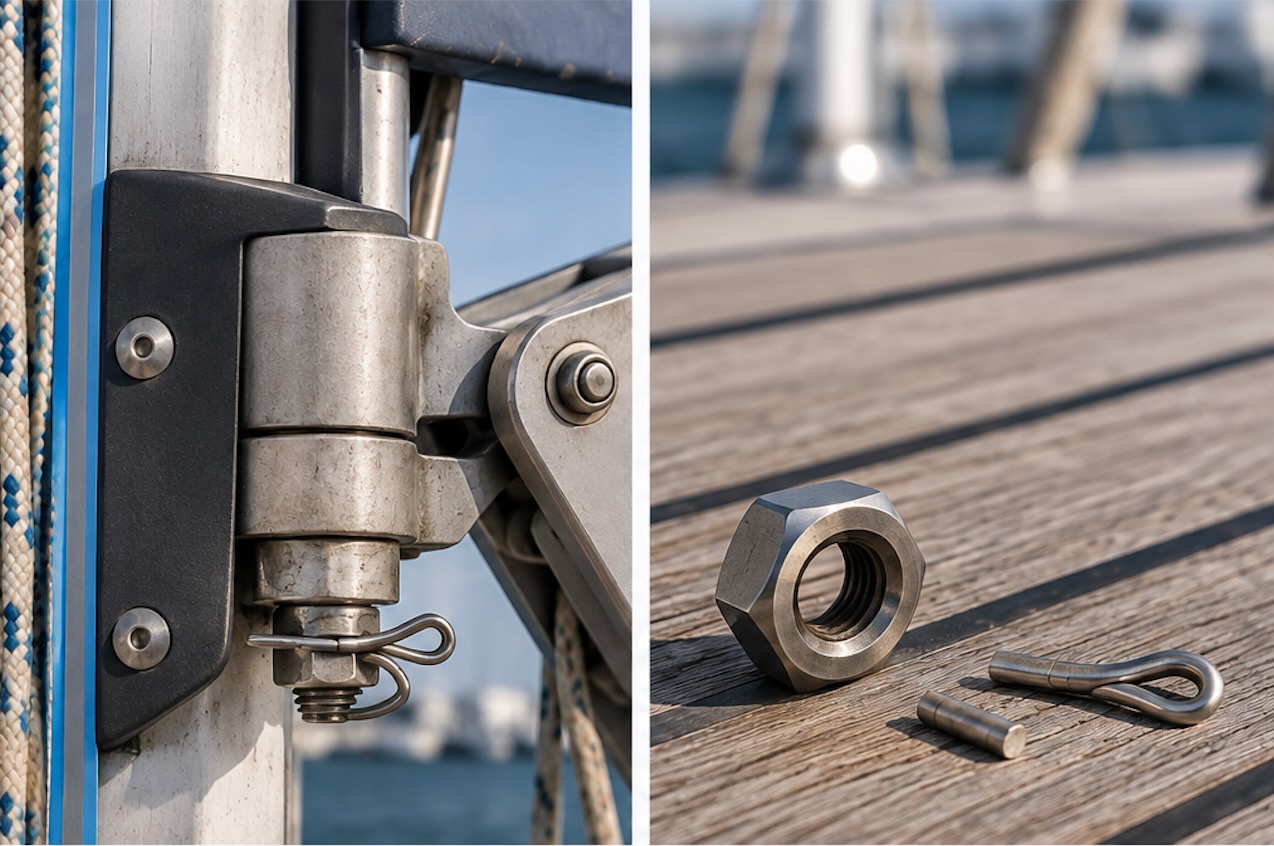
I missed the first warning. I did not miss the second.
Perhaps that is also a good way to understand prevention on board. It is not about believing that we can anticipate absolutely everything. That would be impossible.
It is about observing enough, knowing the yacht well enough and maintaining enough margin so that, when a warning sign appears, we still have options.
After more than 170,000 nautical miles, I still make those rounds around the deck.
Most of the time, I find nothing.
And that is fine.
But there may be a nut lying on deck.
Someone has to see it.
Nacho Lamadrid
Yacht Captain
Lamadrid Yachts
Preparing Yachts for Any Ocean